
Jump to:
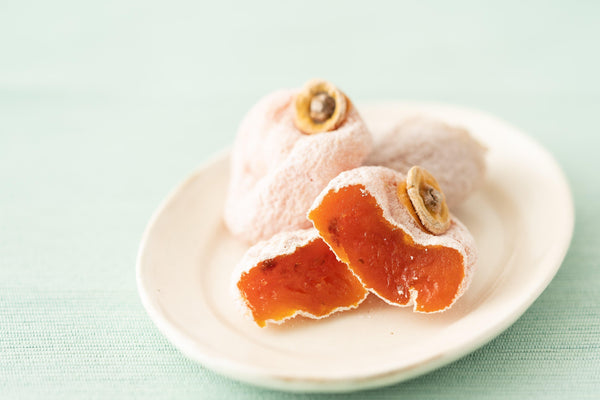
Les Hoshigaki, ou kakis séchés japonais comme nous les connaissons en anglais, sont une collation japonaise saisonnière populaire préparée principalement pendant les mois d'automne, lorsque vous pouvez apercevoir des kakis chargés de leurs fruits orange aux couleurs vives dans tout le pays et dans les supermarchés.
Originally from China, kakis, known as kaki in Japanese, are commonly found in Japan and Korea and make for a sweet, natural snack in their dried form.
In Japan, hoshigaki are said to bring good luck and are often eaten on New Year’s Day in a custom known as Hagatame in Japanese.
How to Make Hoshigaki
Pour faire du hoshigaki, les kakis déshydratés sont massés à la main au cours d'un processus long et intense qui prend entre 4 et 6 semaines avant d'être prêts à être consommés comme collation. Bien qu’il existe des centaines de variétés de kakis, il existe deux catégories principales, astringentes et non astringentes, qui peuvent toutes deux avoir des goûts très différents.

Astringent persimmons are too firm to eat until they become very ripe and taste extremely bitter before this time. The presence of tannins in these kind of persimmons causes the sharp bitterness, and this category of persimmon is known as hachiya in Japanese. The non-astringent varieties of persimmons are known as fuyu in Japanese and taste sweet even when they are still a little firm. Les deux catégories de kakis se distinguent facilement par leur forme, le hachiya est d'apparence plus pointue, tandis que le fuyu est plus rond, semblable en forme à une petite citrouille.
For making hoshigaki, the astringent type of persimmon or hachiya are used. First the tops are cut off the persimmons while still leaving the stem in place, before the skin is peeled. The persimmons are then tied together by the stem with string and hung in sunny windows. In Japan you can often see them hanging outdoors from bamboo poles during the winter months, particularly in rural areas.

The persimmons must be left undisturbed for a week before the daily massaging process begins. This massaging is a delicate process that begins as a light touch before progressing to more of a squeeze. Le hoshigaki est prêt à être consommé au bout de quelques semaines une fois qu'une couche de sucre blanc en poudre s'est formée à la surface et que le kaki prend une couleur orange brûlée. Once ready to eat, the hoshigaki can be stored for approximately several months in an airtight container or frozen.
Where does the Japanese Persimmon Fruit Grow in Japan?
Although persimmon trees are found throughout Japan, there are several regions that specialize in persimmon or kaki production. For example, prefectures to include Yamagata, Niigata, and Nara are all major persimmon growing regions. D'autres variétés de kakis japonaises populaires se trouvent à Fukushima, Yamanashi et Toyama, tandis que la variété la plus connue est le kaki Ichida-kaki que l'on trouve dans la préfecture de Nagano.
You can also try authentique Ichidagaki de Nagano; this premium seasonal variety is available in limited quantities during harvest season. (For a convenient everyday option, try ready-to-eat hoshigaki sticks, pour grignoter à tout moment, toute l'année)

The Ichida-kaki or Ichidagaki as it is also known in Japan are said to have a long history. This variety of hoshigaki is produced in the small town of Takamori in Nagano prefecture in an industry that dates back more than 500 years. La région a commencé à devenir particulièrement connue pour ses hoshigaki dans les années 1920, lorsque les agriculteurs locaux ont inventé le nom « Ichidagaki » et ont commencé à les vendre à travers le pays, dans les grandes villes comme Tokyo et Osaka.

Takamori’s geographical location makes for a particularly good place for producing persimmons. Situé dans un bassin formé par les montagnes environnantes des Alpes japonaises et à proximité de la rivière Tenryu, la température et l'humidité sont idéales pour produire du hoshigaki. The persimmons are harvested annually around the end of October and in November before the process of turning them into hoshigaki begins.
Avantages nutritionnels des kakis entiers séchés
Les kakis sous leur forme originale sont riches en fibres, en vitamine A, en vitamine C et en minéraux, mais ils perdent la majeure partie de la vitamine C lors du processus de séchage. Bien que faibles en gras et entièrement naturels, il convient de garder à l’esprit que les hoshigaki sont assez riches en calories, soit environ 90 à 100 calories par portion.
How to Eat Hoshigaki
Hoshigaki can be eaten on its own as a snack or used in other dishes. When eaten by itself, it is often served with green tea, with the hoshigaki providing a sweet-tasting contrast to the bitter matcha. Il peut également être utilisé dans les salades ou ajouté aux desserts tels que les gâteaux et les glaces. Il est également un ingrédient populaire des wagashi, des friandises japonaises traditionnelles.

Ces dernières années, le hoshigaki est devenu de plus en plus populaire en dehors du Japon et est actuellement à la mode parmi les chefs et la génération Y, apparaissant sur les menus des restaurants branchés ainsi que sur de nombreux flux Instagram.

Si vous souhaitez essayer de fabriquer votre propre hoshigaki, vous pouvez essayer de suivre un atelier en ligne pour apprendre comment fonctionne le processus de séchage avant de le préparer vous-même. Par exemple, un professeur de cuisine basé aux États-Unis Sonoko Sakai organise des cours en ligne à l'automne où vous apprenez à cueillir, éplucher, suspendre et masser les kakis jusqu'à ce qu'ils soient prêts à manger, pour en faire une délicieuse collation ou un cadeau unique fait à la main. En plus du Japon, les kakis sont cultivés dans plusieurs pays occidentaux, notamment en Californie aux États-Unis et dans le sud de l'Europe, alors pourquoi ne pas essayer !


64 commentaires
Hi Jenny, hoshigaki are slightly sweeter and are chewier compared to raw persimmons. In particular, the persimmons used for these hoshigaki (Ishida persimmons) are said to have a moderate sweetness and chewy texture, yet melt in your mouth as soon as you take a bite.
Japanese Taste le
Thank you for the great information! I’m sorry if I missed this, but what do they taste like, in comparison to a raw persimmon?
Jenny le
Hi Chuck, thanks for sharing! We hope that you’ll have better luck the next time you eat a persimmon and that it will be just as good as a chocolate persimmon!
Japanese Taste le
The texture of a raw persimmon is like a hard peach. I have a hybrid persimmon tree which produces chocolate persimmons. A chocolate persimmon is one that has been pollinated. As soon as it develops it is ready to eat and is the sweetest persimmon I have ever eaten. Normally, about 10% of the total fruit on the tree will be chocolate. This year was a bad year. It was quite hot and the fruit ripened before it was mature. We got very few chocolates. You will not find chocolates in the marketplace because it is impossible to tell if it is chocolate until you have cut it open. This year we had close to 500 fruit on the chocolate tree but only about 25 chocolates. I dry the non-pollinated fruit by peeling it and cutting it in quarters and placing the quarters on a cookie cooling sheet with 3/8 " squares. I place them in the sun under a picnic food tent. The white one is best for drying them. It takes about 3 days in the hot late autumn SoCal sun to dry them to where they are sweet to eat. They are not dried in the sense that they are leathery. They are still soft but have turned sweet. You can also sweeten then by freezing them in your refrigerator or by drying them in a food dryer or your oven on its lowest setting. When you dry them in the oven you will see the white tannin running out of the fruit. Time in the oven depends upon how low your lowest setting is. Usually about 4 – 5 hours in my oven.
This afternoon my wife and I shared a fuyu that I purchased at Costco. I think it was picked before it was ripe. It was not as sweet as the fuyu I get off my fuyu tree and not nearly as sweet as the chocolates. It was okay but nothing to rave about.
I have had my kaki trees for about 40 years. It took them almost half that time in order to bear fruit. I have heard that in Japan it is at least 14 years before they bear good fruit in any quantity.
Chuck le
Hi Jenny, hoshigaki are slightly sweeter and are chewier compared to raw persimmons. In particular, the persimmons used for these hoshigaki (Ishida persimmons) are said to have a moderate sweetness and chewy texture, yet melt in your mouth as soon as you take a bite.
Japanese Taste le
Thank you for the great information! I’m sorry if I missed this, but what do they taste like, in comparison to a raw persimmon?
Jenny le